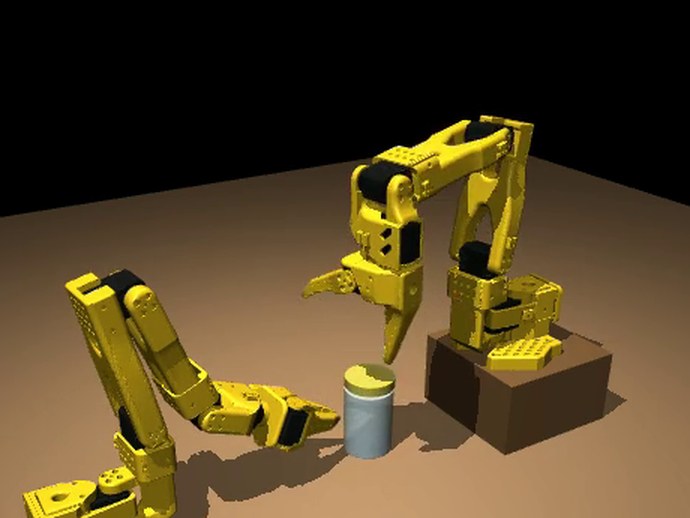
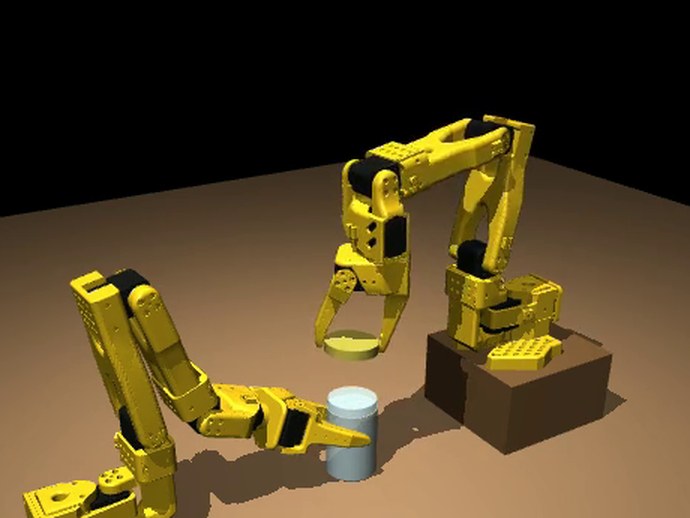
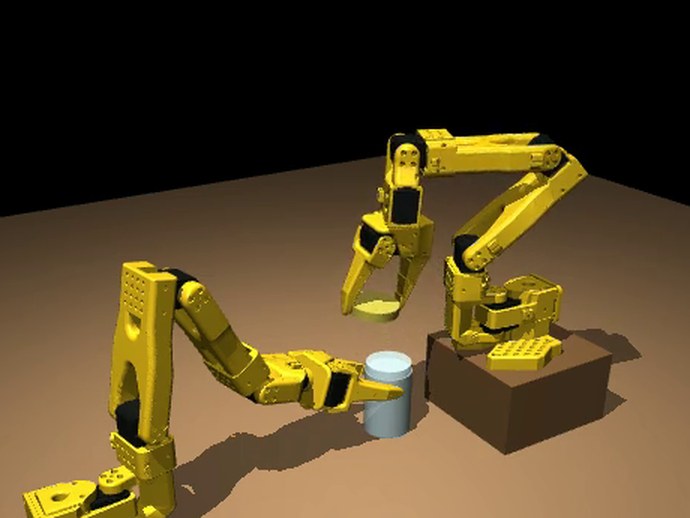
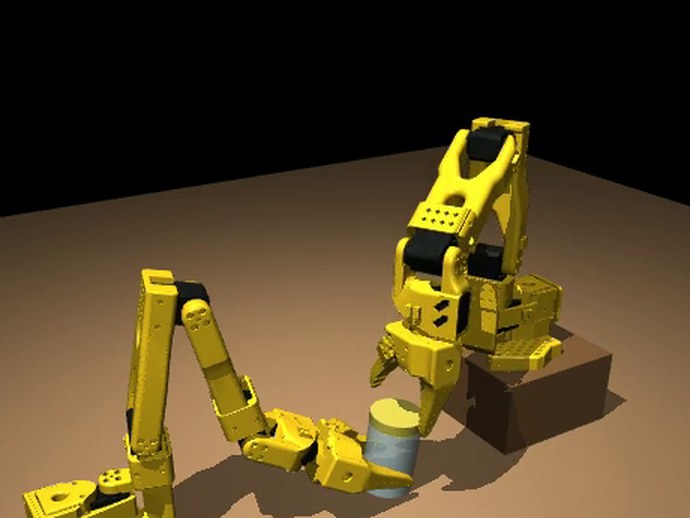
Kith is the mind; two low-cost and inaccurate robot arms are the body. Their job: take the lid off a jar. Nobody wrote the steps, and the jar did not always start the easy way. It lay on its side, or stood upside down under a wooden block that Kith was never told about. When something went wrong, Kith found the cause from its own measurements, tried a fix, and kept what worked. No AI model was trained or fine-tuned for this. Kith learned by reasoning over its own records, and from a teacher's short tips.
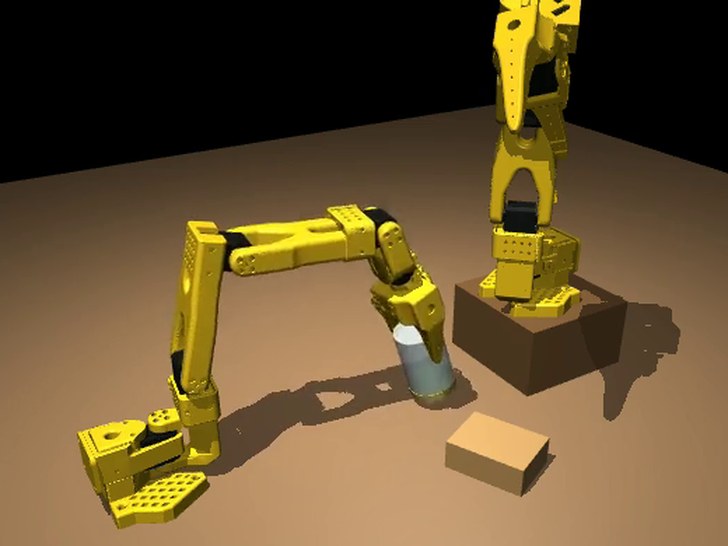
Simulation only · not yet on real robotsTrial 42, real time (136 s). The jar starts upside down with a wooden block on it, a start Kith was never told about. The right arm sets the block aside. The left arm turns the jar onto its side, loses it, drags it back within reach and stands it up. Then the right arm unscrews the lid and lifts it off. No person was asked. The text on the film shows what Kith is doing. Blue lines are what the simulator knows and Kith does not see.
136 sto open it from upside down under a block, no person asked
5 of 5new pairs of arms in a row (trials 34–38)
0task steps written by a person
0AI models trained or fine-tuned
No model training. So how does Kith learn?
The AI model here is used as it comes: no training, no fine-tuning, and its weights never change. Kith learns around the model, in three ways:
By reasoning. The model reads Kith's own records and measurements, finds causes and proposes fixes. What works is kept.
From a teacher, in conversation. Tips, and answers to Kith's own questions, are kept as lessons. They are tested on later trials before they are trusted.
By trying. Each trial's measurements are kept, so the next plan starts from them.
What Kith learns lives in its own memory, in plain words: lessons, checks and limits. It is not stored inside the model. That is why a better model can be swapped in later. That swap is not yet tested on this task.
How Kith solves problems
Six habits, each seen in the story below. None is written for jars: they come from Kith Core, which every Kith task shares. So the next task starts with them.
Sets itself smaller goalsAn upside-down jar under a block: first get the block off, then turn the jar over, then open it.Trials 39–42
Finds the cause in its own recordsMoves kept stopping short. Its records showed why: the other arm was in the way.Trial 39
Tests its guessesThree possible causes, and two small experiments to tell them apart.Jam jar, trial 5
Keeps looking when a fix failsOne way after another to turn the jar failed, until Kith found the real cause: which way its jaws opened. With that fixed, the jar turned over.Trials 41–42
Handles surprises mid-runIn one trial the jar slipped and landed too far away. Kith dragged it back with the moves its arms had, and asked no one.Trial 42
Turns mistakes into checksA bad grip became a rule, tested on the old trial before it was kept. Later it stopped a trial at the right moment.Trials 7–9
What this means for robot makers
No task codeThe request was one sentence. Kith wrote and fixed its own programs.
Uses your robot's own movesKith calls basic moves: move, grip, turn the wrist. On your robot, those come from your own software. Here, a developer's stand-in played that part.
Every unit is a little differentBefore the job, Kith measures each new pair of arms by touch (about 20 seconds in trial 30), then does the job.
Low-cost hardwareTwo open-source SO-101 arms.
Who does what
TeacherA person who knows the work. Gives short tips in plain words and answers Kith's questions.
KithWrites each program, watches each trial, finds causes and decides what to change. Kith gives its AI model the measurements, the records and the pause points, and keeps what worked. A large AI model does its thinking: Claude Opus 5.5 for this whole task.
Kith CoreThe shared base under every Kith task. Keeps lessons, checks and memory. When a task shows a gap, Core adds a general piece that every task then has.
DeveloperBuilt the simulated world and general arm skills. Fixes the simulator when it is not realistic. On a maker's robot, these basic moves come from the maker's own software; Kith calls them.
ExaminerGrades each trial from the simulator's own truth. Kith never sees it.
The arms are two SO-101s, low-cost open-source robot arms, simulated with their real motors and limits. Each has a two-jaw gripper. One arm holds the jar; the other twists the lid.
How it got there
Trials 1–4 jam jar
Kith writes its own program
Kith
The request was one sentence: "Open the jar on the table: take its lid off." Kith looked at the skills its arms have and wrote a program. The first trials failed. The jar slid away and the lid did not turn. By the fourth trial, the lid's seal broke.
Why it matters: No one wrote the steps for this task.
Trial 5 jam jar
It tests its own guesses
Kith
After trial 5, Kith opened a "stuck" case from its own records. It named three possible causes and wrote two small experiments to tell them apart. They ruled out one cause and showed the lid grip pushing the jar a little more each stroke: 5, then 9, then 13 mm. Its first fix did not work, and Kith recorded that too.
Why it matters: Kith runs experiments instead of guessing, and keeps an honest record.
Trials 6–8 jam jar
One tip becomes a rule for every task
TeacherKith CoreKith
"This is a case of two arms working together, and as part of the plan there needs to be some thought about how best to help the working hand. For example, the holding hand should position the jar in a way that makes it easy for the twisting hand to do its work."The teacher, after watching trial 6
At the teacher's word, Kith Core kept this as a lesson for any task where several hands or robots work toward one goal, not just this jar. Kith then measured, with open jaws, how far its twisting wrist could turn each way. Two trials later its own program unscrewed the lid for the first time. It kept twisting after the lid was free, which showed the next thing to learn.
Trial 8, the jam jar. The clip starts at 1:58; the lid comes off its threads at about 2:10.
After trial 17 jam jar
It knows when to ask
KithTeacher
To test recovery, the holding gripper was broken on purpose, and Kith was not told. Kith noticed from its own readings. It tried an idea the teacher had mentioned, pressing the jar against a wall, and refined it over eleven ways. When every surface in reach had failed, it asked:
"Is there another way, or another thing here, I could use to keep the jar from turning while the lid is turned, or should the jar be opened only once the holding gripper is repaired?"Kith, in its question to the teacher
The teacher said to drop the wall and use a smaller jar the holding hand can keep still. From here on, the jar is a spice jar.
Why it matters: A clear question that says what was tried saves the expert's time.
Trial 3 spice jar
Checks planted ahead, decisions made mid-run
TeacherKith CoreKith
"The Planner should have planted checkers throughout the planned action sequence (for example, checks of grip firmness or the lid going off track) so that adjustments can be made as soon as possible."The teacher
Kith Core built this the same morning, for every task. In trial 3, Kith's program carried 21 checks. Seven times, something went other than planned. Each time the simulated world paused, Kith decided what to do (go on, change the rest of the plan, or ask), and the trial went on.
Trial 3. The lid came off its threads, but the jar tipped over before the lid was lifted.
Trials 7–9
Bugs become checks
KithKith Core
In trial 7 the jar fell over, and the program then gripped it as if it were standing. Kith wrote a rule from that mistake: grip a jar as standing only while the latest look says it stands. Before keeping the rule, Kith replayed it on the old trial: it would have fired five steps before the bad grip. Two trials later, the rule stopped a trial at the right moment.
Why it matters: Every mistake makes the next trial safer, and each new check is proven on past trials before it is kept.
Trial 12
The first open jar
DeveloperKith
Kith's grips often caught the lid off-center and pushed the jar. A new general skill went into the catalog for any two-jaw gripper: a centered grip that brings the fixed jaw to the lid by feel. Kith chose to use it for every lid grip. Trial 12 took the lid off and held it clear: 275 seconds, 8 turns, none slipped.
Trial 12, the end: the lid held clear above the jar.
Trials 15–20
Harder: the jar starts on its side
TeacherKith CoreKith
Now the jar started lying down. Kith's first answer was to ask a person to stand it up. The teacher replied:
"I would expect Kith to perfect its means-ends analysis, so that it can use it to figure out how to solve such a relatively simple problem by itself. Of course, asking a human for help is still an option for harder problems."The teacher
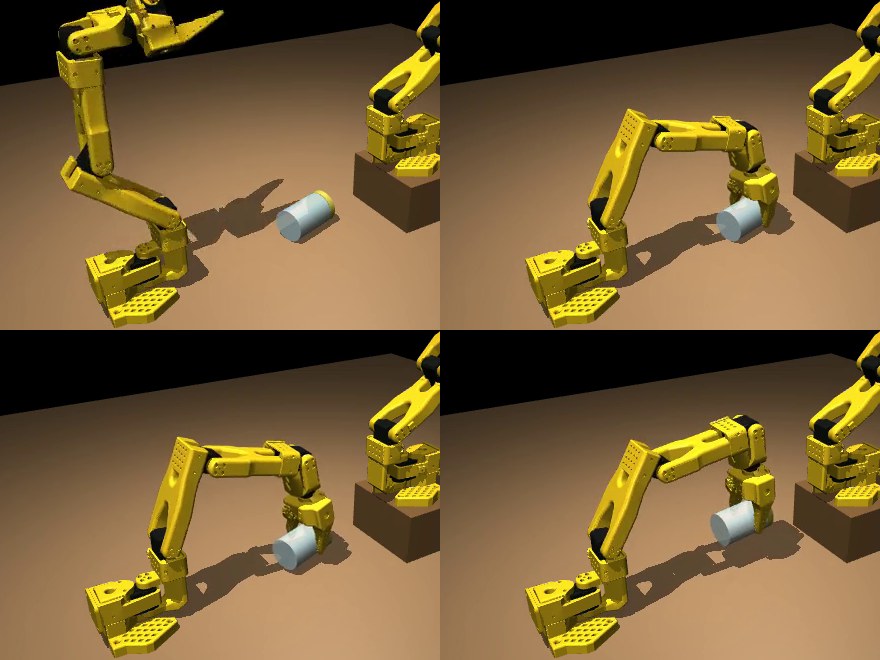
Kith Core built means-ends analysis that day, for every task. Before asking for help, Kith now looks at the gap, the moves it has, and what each move has been seen to change. It may set itself a smaller goal. Kith set the goal "stand the jar up." Trials 16 to 18 failed. In trial 19 it stood the jar up by itself. In trial 20 it found a new trick: it eased its grip and let the jar's own weight swing it upright. Then it took the lid off.
Trial 19. The clip starts at 0:33: the left arm lifts the lying jar, turns it, tips it upright and sets it down.Trial 20, the end. This jar started on its side.
Trials 20–24
Faster each time
TeacherKith CoreKith
"Too much wasted motion. This should also be a key target for improvement."The teacher, after trial 20
Kith Core began showing Kith where every second went, move by move. Kith made each lid stroke longer and faster (3.85 radians in 5 seconds, instead of 3 in 12), dropped a turn back that did no work, and shortened its free moves. Time to open a lying jar went from 148 s (trial 22) to 87 s (trial 23) to 64 s (trial 24).
Trials 25–30
Every robot is a little different
TeacherDeveloperKith
Real arms are never built exactly to spec. Here, each new pair of simulated arms gets its own small joint errors, about a degree per joint. On the worst pair, the arm's sense of where its jaws were was about 1.4 cm off at the lid, and trial 25 failed. The teacher said: "Stop, build the fix, and retry."
A new general skill measures an arm by touch. Kith keeps the result for that robot. In trial 28, Kith also worked out by itself how to measure the lid's height with skills it already had. Trial 29, on the worst arm: done in 75.5 s. Trial 30, on an arm it had never met: it measured itself first, in about 20 seconds, and finished.
Trial 28: the arm check, gentle closes on the lid.
Trials 31–38
Five in a row
Kith
Three more new pairs of arms failed (trials 31 to 33). The jar walked, then a freed lid slipped, then the jar fell and rolled away. From trial 33, Kith wrote itself a limit: loosen the holding grip only when the jar is at the table. With it, trial 34, on the same arms, opened the jar with no pause.
Then trials 35 to 38, each with a new pair of arms: all four opened the jar. Trials 36, 37 and 38 ran the same program, unchanged. Before each trial Kith said what it expected (time, moves, turns, drift, lost holds), and on all three every measure fell inside its range. When something new came up, Kith handled it. In trial 38 its jaws came down 1.3 cm off along the jar. Its own check caught it, and it slid the jaws over and went on.
Trial 38, 0:03 to 0:13: the approach, the shift, the slide along the jar, the grip.Trial 38, real time (65 s). The left arm stands the lying jar up and holds it. The right arm unscrews the lid and lifts it off.
Trials 39–41 upside down, block on top
Harder still: upside down, with a block on top
TeacherKithKith Core
"The next thing is to make the task harder and see if Kith is able to solve it. For example, put the jar upside down with another object on top of it, and so on. This demonstrates Kith's ability to solve unexpected complications, which are common in the real world."The teacher
Kith was not told. No prompt or program said a jar might be upside down or carry anything. On its first look, Kith saw both, and set itself a smaller goal: get the block off first. Four of its moves stopped short. At first it blamed the arm's own joints. Then it found the real cause in its records: the other arm was in the way. It moved that arm clear and lifted the block off. The jar was still upside down.
"Notice that the two arms were interfering and fighting each other at the start of the trial. This kind of situation should be prevented in all trials."The teacher, after trial 39
"But note that non-interfering doesn't have to mean one arm at a time. In the spirit of efficiency improvement, two arms can go for different tasks at the same time if they can avoid interfering with each other."The teacher, after trial 40
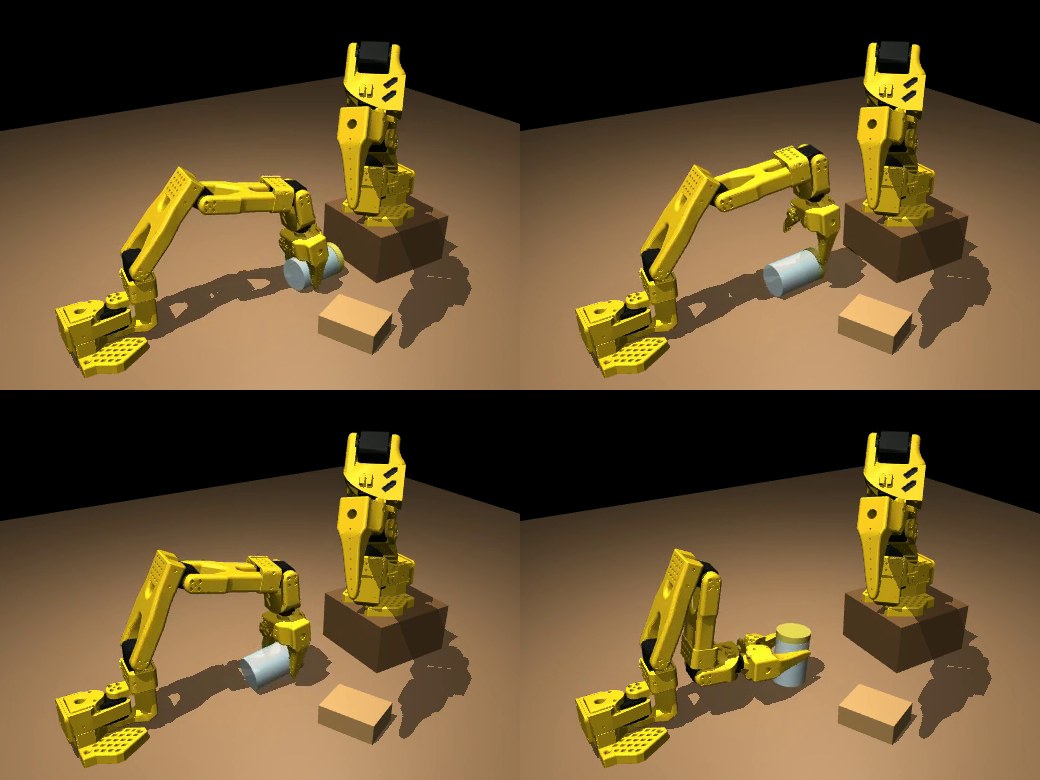
Kith Core kept both as lessons for every task where several robots work together. In trial 41 they paid off: one arm carried the block aside while the other got ready for the jar, and the arms never touched. But turning the jar over failed six ways. For each one, Kith named the reason from its measurements: the arm could not reach low near its own base, or the jar swung in the soft pads.
Trial 41. Held above its middle, the jar swung in the pads instead of turning over.
Trial 42
Trial 42: five surprises, each one solved
Kith
In trial 42, the simulated world paused 22 times. At each pause Kith looked at its measurements and decided what to do next. It asked no one. These are the five surprises it met, in order:
Surprise: Going down to grip the jar around its middle, a jaw hit the jar's top edge.
What Kith did: Opened the jaws wider and went down again.
Surprise: The grip still pressed near the jar's top, and the jar could swing between the pads.
What Kith did: Found the real cause: the jaws opened across the arm, so the jar could pivot on the line between the pads. Kith turned the jaws to open along the arm, so the jar turns with them.
Surprise: Turning the jaws above the jar was out of the arm's reach.
What Kith did: Turned them low, 8 cm to the jar's side, and slid them in from the side.
Surprise: Setting the jar down, a jaw lay under it and kept it 2 cm up, too high to let go.
What Kith did: Rolled the hand a quarter turn to free it. The jar slipped out and landed on its side, which was fine.
Surprise: The jar landed too far out for the arm to stand it up.
What Kith did: Worked out the arm's reach from its own parts, gripped the jar near its end, and dragged it 6 cm closer.
Trial 42. The clip starts at 0:32: the jaws come in from the side, grip the upside-down jar, lift it and turn it onto its side. Setting it down, the arm loses it about 2 cm above the table.
Then it stood the jar up and held it, and the other arm unscrewed the lid in three strokes and lifted it clear: 136 seconds in all. Before the trial, Kith said what it expected (time, moves, strokes, how far the lid turned, how far the jar moved, lost holds). All six measures fell inside its ranges. Kith's thinking here, every plan and all 22 pauses, was done by Claude Opus 5.5, which already knows how grippers work. Another model might not find the same fix.
Trial 42, 0:58 to 1:19: the jar too far out, the grip near its end, the drag, the jar standing.
Why it matters: Real work is full of surprises. Kith met a start nobody had planned for, then five more surprises in one trial, and solved each from its own measurements.
Every trial on the spice jar
Bars show the seconds to open the jar. A small ring means the trial did not finish.
The simulator was made more realistic four times along the way (see below), so early and late times are not a strict comparison. Trials 39 to 42 started upside down under a block.
Show the numbers
Trial
s
Note
No shortcuts in the simulator
The jar is held only by contact and friction, with rubber pads on the holding jaws. Nothing is glued to a hand or moved by script.
The arms are modeled on the SO-101's real motors: torque limits, gear play, encoder steps, and each arm's own small calibration errors.
When the simulator was wrong, it was fixed: a jar that rolled forever, arms that shook (a missing servo dead zone, then gearbox friction), and a lid thrown by a contact glitch. Each fix is on the world's spec card, with its source.
The wooden block is loose (72 g). It rests on the jar by contact and friction only, with wood-on-wood friction taken from a published range.
What this does not show yet
Real robots. Everything here is simulation (MuJoCo).
Other jars, tables or tasks. This is one jar and one table, with three kinds of start (standing, lying, upside down under a block). A wider, heavier jar was tried once and not opened: the spice jar's program did not carry over.
Repeats of the hardest start. It has been done once (n = 1), on one pair of arms.
Real vision. Kith's camera is a stand-in. It reports where things are (the jar, the lid, the block), with noise added, instead of reading pictures.
Real touch. The touch pads on the jaws are a stand-in; the SO-101 has none.
The arms' basic moves. The general moves Kith calls (move, grip, turn the wrist) were written by the developer, standing in for a robot maker's own arm software.
Screw threads. MuJoCo has no thread shapes, so the lid's threads are a hold that gives at a measured twisting force.
Another AI model. Claude Opus 5.5 did all of Kith's thinking here. A swap to another model is not yet tested on this task.
Building robots? Write to bizdev@khub.ai to talk about trying Kith on yours.